


James Polk
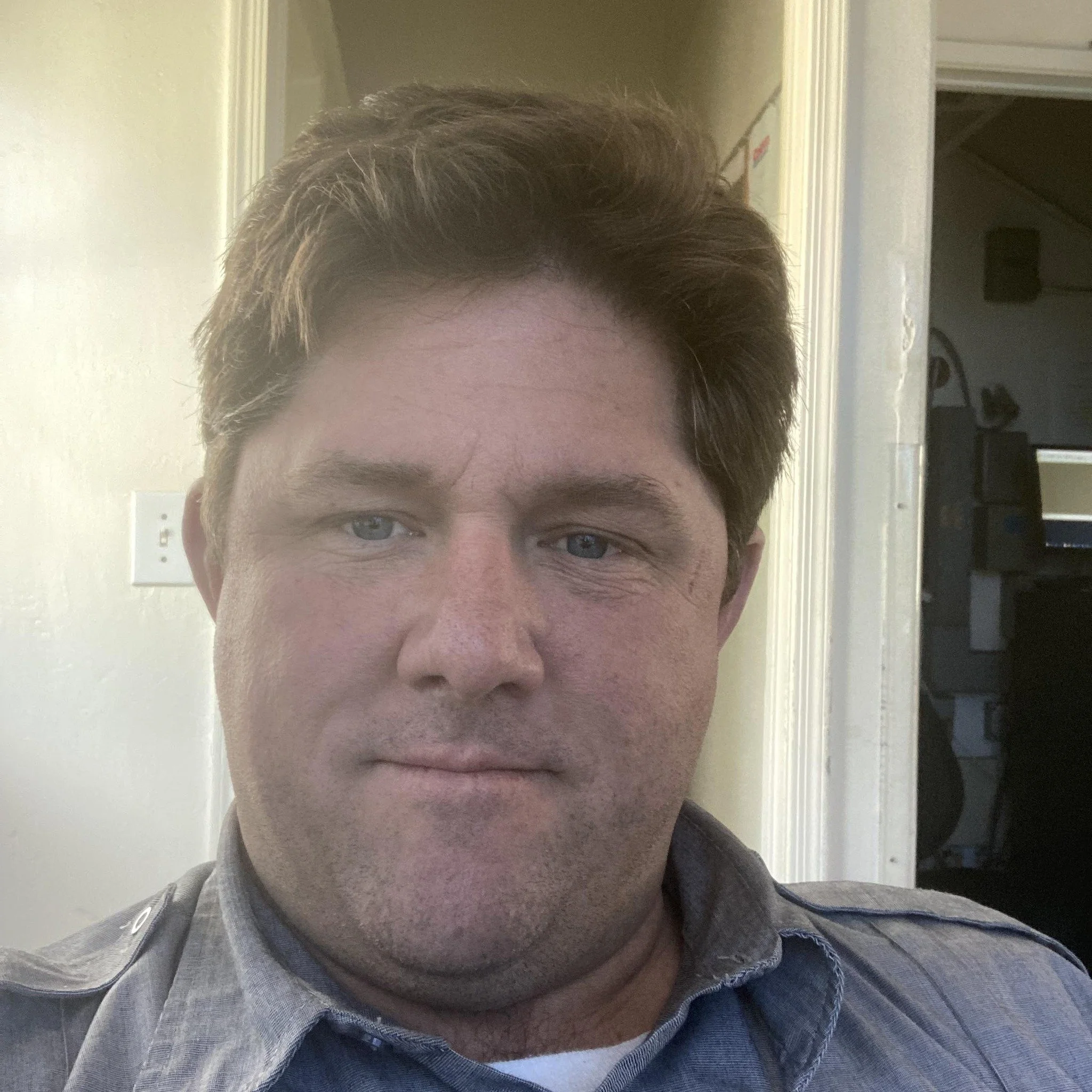
James Polk: Learning Endurance Before He Knew Its Name
We met James Polk at Community Lutheran Church, introduced by Maria Dangel, the Director of Discipleship. It didn’t take long to notice something steady about him: not loud, not flashy, but grounded. The kind of presence that suggests a long obedience, formed quietly over time.
That steadiness did not come from a sudden calling or a dramatic moment. In fact, James will tell you that his concern for victims of human trafficking didn’t begin with a cause or a category at all. It began with people.
During his years with Young Life, working closely with students on juvenile probation, he started noticing patterns he couldn’t ignore. Young people carrying more trauma than they could name. Instability at home. Early exposure to substances. Blurred boundaries. A deep mistrust of authority paired with a quiet hunger for someone who would actually stay. What unsettled him most was not only the pain, but the fragmentation of care. Schools, counselors, probation officers, churches, families—all involved, but rarely coordinated.
Over time, James sensed the Lord pressing something deeper on his heart. This wasn’t merely a social problem to be reacted to, but a vocational question. One that sat at the intersection of justice and mercy. Through prayer, failure, and theological clarification, he came to see that God was not calling him to fight evil in the abstract, but to care for people who had already been deeply harmed.
That realization makes more sense once you hear his story.
James grew up in Escondido, California, near Lake Hodges, but some of his most formative years were spent far from there, in New Mexico. Beginning around the age of five, his father would take him hiking in the Sandia Mountains. Long distances. Heavy packs. Nights on the trail. Those hikes weren’t framed as lessons, but they taught him endurance all the same: how to prepare, how to keep going, how formation often happens long before we have words for it.
At home, life revolved around building and fixing. James was always taking things apart and putting them back together, constructing small machines, climbing trees, drawing, staying active in sports. Productivity, organization, and problem-solving were part of the air he breathed, reinforced by parents, neighbors who were mechanics, and a broader family heritage shaped by engineering, scouting, and disciplined craftsmanship. Looking back, he can see how these early years formed not only his hands, but his instincts: structure matters, systems matter, and things fall apart when care is not intentional.
Faith took root in much the same way. Quietly and personally. Before his baptism in high school, James’s faith was already real. As a child, he remembers sitting in church, studying stained-glass depictions of Christ’s passion, praying with an earnestness only a child can muster. Once, he prayed that he would never run away like the disciples, that he would stand his ground with Jesus, even if he didn’t fully understand what that meant.
Baptism, in an LCMS congregation during his high school years, brought clarity. While reading the Book of Romans with his youth group, James came to see that only God is good, and that apart from Christ, we cannot save ourselves. Grace alone stopped being an idea and became a necessity. That conviction has remained a steady anchor ever since.
High school further shaped his sense of responsibility. James balanced academics with athletics, serving as a three-year starter on the varsity football offensive line, team captain his senior year, and president of the school’s Christian club. Coaches, teachers, and youth leaders helped form his confidence and discipline, reinforcing the idea that leadership is exercised not through control, but through consistency and accountability. These experiences eventually led him to pursue theological studies at California Lutheran University.
At Cal Lutheran, his convictions were tested and refined. He was exposed to progressive theological frameworks that challenged his assumptions, yet the doctrine of the Trinity remained a firm anchor. Over time, James returned fully and consciously to confessional Lutheran theology, persuaded by the clarity of Law and Gospel, the means of grace, and the sufficiency of Christ. This theological grounding would later become essential, especially as he began wrestling with ministry in complex and broken spaces.
After college, James returned to frontline ministry as a Young Life Area Director. Working with students facing serious legal and family challenges confronted him with the limits of preparation. One moment still stays with him: a student showing up carrying drug paraphernalia. I am not prepared for this, he thought. What followed involved counselors, probation officers, family members, and difficult conversations. It was messy and humbling, but it taught him something essential. Compassion without structure burns out. Structure without compassion hardens. Ministry requires both.
His service in the Church continued in many forms: church council president, staff member at a Lutheran summer day camp, football coach. Coaching, especially, gave him a sober realism about suffering and discipline, about forming people patiently rather than fixing them quickly. A brief season in the United States Marine Corps Reserve further strengthened his appreciation for restraint, duty, teamwork, and accountability. Especially the quiet perseverance required when no one is watching.
Later, James pursued paralegal training and business education, not as a departure from ministry, but as a way to serve the Church more faithfully. He learned how systems can either protect people or fail them. He discovered a natural affinity for building frameworks that allow diverse gifts to work together responsibly, especially when serving vulnerable populations.
All of this shapes his vision today—a vision he describes as intentionally modest and intentionally Lutheran. James does not believe every congregation is called to direct rescue work, nor that faithfulness requires churches to overextend themselves or reinvent what others are already doing well. Instead, he sees the Church’s strength in ordered, consistent faithfulness: prayer, material support, administrative help, basic repairs, research assistance, and relational presence.
James sees himself helping quietly and concretely. Coordinating a few congregations to support a trusted Christian ministry. Helping a church council understand how to participate without fear or confusion. Supporting professionals (counselors, advocates, legal workers) so they can focus on direct care while the Church stands behind them, steady and faithful. A victim may never know his name, but may still be served because the Church showed up.
That vision is now being discerned and shaped in collaboration with Lutheran Mission Society San Diego. Rather than pushing urgency or spectacle, LMSSD has given James space to slow down, clarify, and listen. Through patient conversations, theological care, and pastoral accompaniment, he has been encouraged to remain firmly Lutheran—not only in doctrine, but in tone, posture, and expectations.
This discernment is taking concrete shape through Praxis Professional, a nonprofit designed to help LCMS congregations take small, faithful steps in supporting victims of human trafficking. Rather than overwhelming churches, Praxis focuses on simple, coordinated volunteer efforts each year, partnered with trusted Christian ministries already providing direct care.
James is not chasing something grand. His hope is quieter than that—to help congregations practice ordinary obedience, trusting that the Lord works through faithfulness to bring mercy, healing, and hope. When all is said and done, he prays to be found faithful to Christ’s Great Commission, sharing the gospel in the name of the Father, Son, and Holy Spirit.
And perhaps that’s what those early hikes were really about after all.